

“Who Is the Man in the Shroud?”
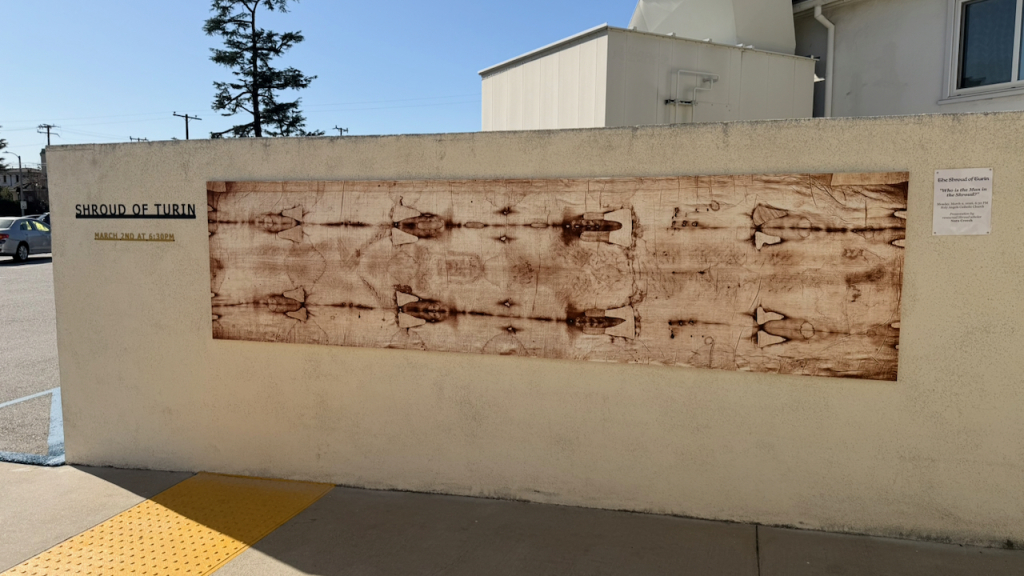
We have added a permanent replica of the Shroud of Turin to our Sacred Heart Chapel, located near the main entrance of the church. As you enter, you are warmly invited to pause, admire, and prayerfully contemplate the Shroud—an enduring sign that draws us into the mystery of Christ’s Passion, Death, and Resurrection.
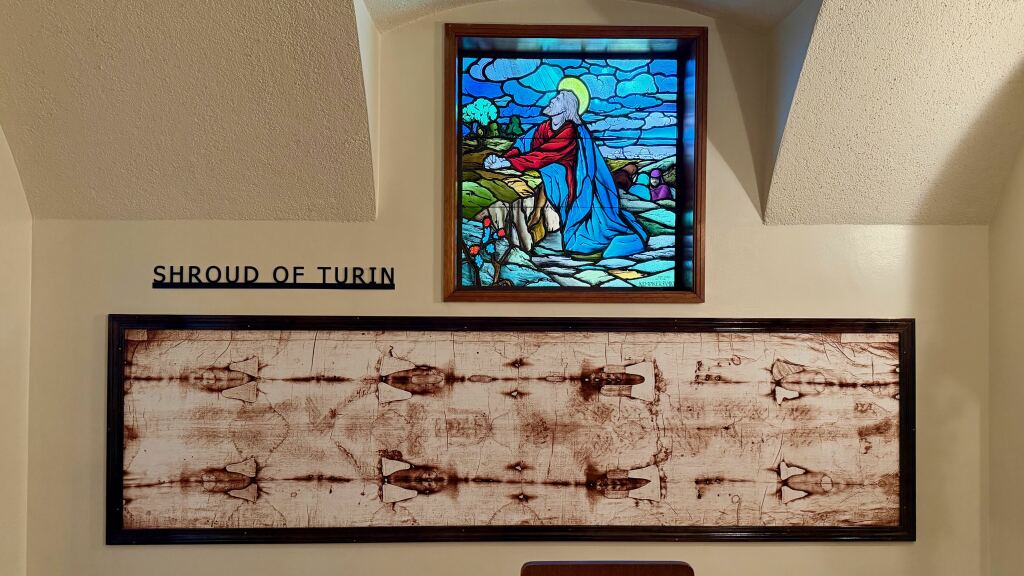
“When Simon Peter arrived after him, he went into the tomb and saw the burial cloths there, and the cloth that had covered his head, not with the burial cloths but rolled up in a separate place. Then the other disciple also went in, the one who had arrived at the tomb first, and he saw and believed.”
— John 20:6–8
What Is the Shroud of Turin?
The Shroud of Turin, housed since 1578 in the Cathedral of San Giovanni Battista in Turin, Italy, is a controversial linen cloth made from flax, measuring approximately 14 feet by 3.5 feet. It bears a faint image of the front and back of a naked man, along with bloodstains consistent with the scourging and crucifixion of Jesus of Nazareth as described in the Gospel of John.
Different cultures have used burial shrouds for thousands of years. In a Jewish burial, the body is usually washed before wrapping. However, in the event of violent death with significant blood loss, the body is simply wrapped in a large cloth called a sovev — meaning "to surround." In the case of the Shroud of Turin, everything correlates with the burial of a man who died a violent death, consistent with the biblical account of Joseph of Arimathea, described as "a rich man," who purchased the cloth.
Reference: Understanding the Shroud of Turin by Russ Breault | The Shroud of Jesus by Dr. Gilbert Lavoie
“After this, Joseph of Arimathea, secretly a disciple of Jesus for fear of the Jews, asked Pilate if he could remove the body of Jesus… They took the body of Jesus and bound it with burial cloths along with the spices, according to the Jewish burial custom…”
— John 19:38–42
A History of the Shroud
While the Shroud is first clearly documented in 14th‑century France, history preserves numerous accounts of sacred cloths associated with Christ long before that time. The question is not whether the Shroud appeared suddenly, but whether it may have traveled quietly through history — revered, protected, and sometimes hidden — before emerging into public view.
Reference: Possible Post-Biblical and Pre-1350s References in History to the Shroud of Jesus by Joseph "Joe" Marino.
When the World Has Seen the Shroud — A Timeline
A Pope Holds the Shroud Himself
Pope Pius VII presided over two extraordinary expositions during the Napoleonic era. In 1815, after Napoleon's defeat, he personally held the Shroud from the balcony of Palazzo Madama — an event never repeated in history.
A Saint Before the Shroud
St. John Paul II visited, prayed, and venerated the Shroud, describing it as a “mirror of the Gospel.”
The Great Jubilee Exposition
During the Jubilee Year, the Shroud was displayed for more than two months, drawing millions of pilgrims from around the world.
Faith and Reflection
Pope Benedict XVI visited and offered a profound meditation on the mystery of the Shroud, reflecting on suffering, hope, and the Resurrection.
Seen Only Through the Screen
Benedict XVI authorized a television-only exposition. Pope Francis offered a message the same day, reminding viewers that the Shroud speaks quietly but powerfully to the heart.
Pope Francis in Turin
Pope Francis visited the Shroud and spoke of it as an icon of love, suffering, and mercy.
A Sign of Hope During the Pandemic
The Shroud was shown through a special livestreamed exposition. Millions joined spiritually from their homes, encouraged by Pope Francis.
Why Is Seeing the Shroud So Rare?
The Shroud of Turin is not on permanent display. It is carefully preserved and shown only on exceptional occasions — often decades apart — due to its fragility, historical importance, and spiritual significance. Each exposition is considered a moment of grace, inviting believers and seekers alike to pause, reflect, and encounter the mystery of Christ's Passion.
“Put your finger here and see my hands, and bring your hand and put it into my side, and do not be unbelieving, but believe.”
— John 20:27
Watch & Learn
Nora Creech — Othonia Shroud Overview
The Shroud of Turin: History's Most Controversial Relic
History Channel — The UnXplained: The Mystery Behind the Shroud of Turin
Holy Angels Parish